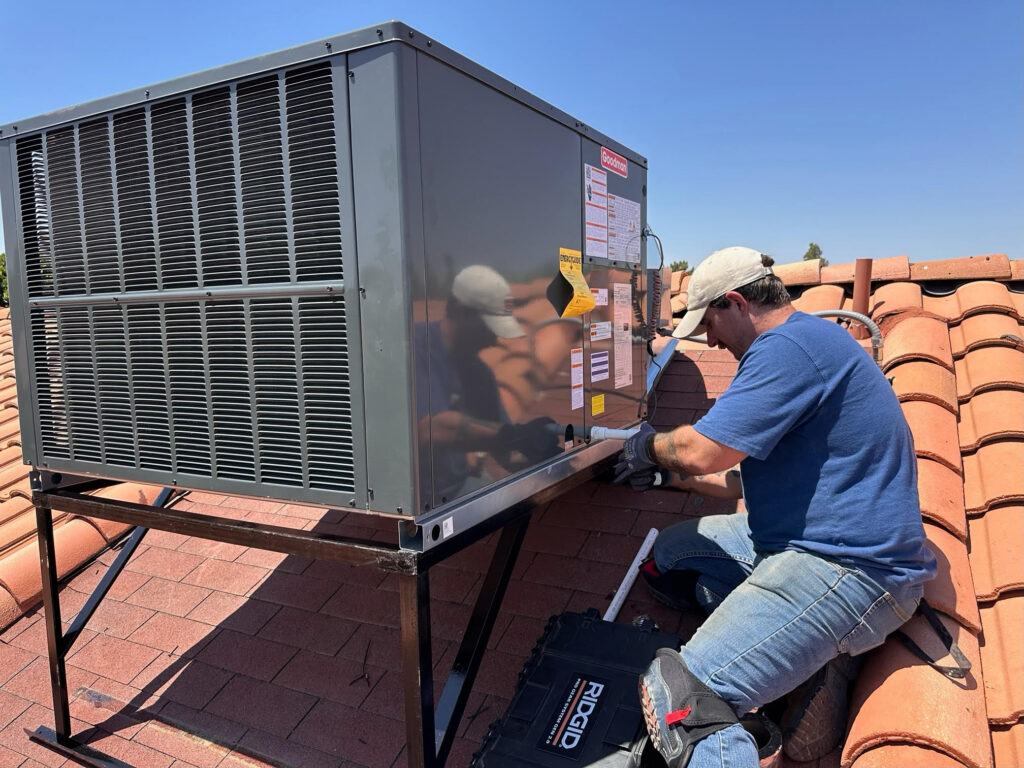
Look across the rooftops of homes and buildings throughout Arizona and you’ll notice something that isn’t nearly as common in many other parts of the country: HVAC equipment installed directly on the roof.
Rooftop air conditioners and packaged HVAC systems are a familiar sight across the Valley. Instead of separating major heating and cooling components between indoor and outdoor locations, many rooftop systems combine much of the equipment into a single packaged unit.
That design can make sense for certain Arizona properties, but rooftop HVAC equipment also faces unique challenges. Direct sunlight, extreme summer temperatures, dust, monsoon conditions, roof access, equipment age, and installation quality can all influence how the system performs.
If you own a home with rooftop HVAC equipment, understanding what is above you can make AC repairs, maintenance, and eventual replacement much easier to navigate.
What Is a Rooftop AC Unit?
A rooftop AC unit is an HVAC system installed on the roof rather than at ground level beside the home.
Many residential rooftop systems are packaged units. Instead of having an outdoor condenser and a separate indoor air handler or furnace, major heating and cooling components are housed together in one cabinet.
Depending on the equipment, a packaged rooftop system may provide:
- Air conditioning
- Electric heating
- Gas heating
- Heat pump heating and cooling
- Air circulation and filtration
Ductwork connects the rooftop equipment to the interior of the home, distributing conditioned air to individual rooms.
This differs from a traditional split HVAC system, where the outdoor condenser sits outside the home and other components are located indoors.
Why Are So Many AC Units on the Roof in Arizona?
Rooftop HVAC installations can offer practical advantages for certain homes and properties.
They Save Ground-Level Space
Placing HVAC equipment on the roof eliminates the need for a large condenser beside the home.
That can be useful on properties where yard space, patios, walkways, landscaping, or lot configuration make ground-level equipment inconvenient.
Packaged Equipment Keeps Components Together
A packaged HVAC unit combines major components in one cabinet. This can simplify certain aspects of system design and eliminate the need to dedicate indoor space to some HVAC equipment.
Rooftop HVAC Is Common in the Southwest
Many Arizona properties were designed around rooftop HVAC systems from the beginning. Existing ductwork, roof penetrations, electrical connections, gas lines, and equipment platforms may all be configured specifically for a packaged rooftop unit.
When replacement time arrives, homeowners often choose another compatible packaged system rather than redesigning the home’s entire HVAC configuration.
Rooftop AC vs. Split-System AC
Neither configuration is automatically better for every Arizona home.
The right system depends on the property, existing HVAC infrastructure, equipment goals, budget, efficiency priorities, and installation requirements.
Rooftop Packaged AC
A rooftop packaged system generally keeps the primary HVAC equipment together outside the living space.
Potential advantages include:
- No ground-level condenser
- Less indoor equipment
- A compact packaged design
- Compatibility with homes already designed for rooftop HVAC
Potential considerations include:
- Roof access for service
- Exposure to Arizona weather
- Installation and lifting requirements
- Roof condition during equipment replacement
Split-System AC
A split system typically uses an outdoor condenser combined with indoor equipment.
Potential advantages can include:
- Easier ground-level access to the outdoor condenser
- Broad equipment availability
- Many efficiency and configuration choices
- Separation of indoor and outdoor components
The best choice is usually influenced by how the home was constructed and what equipment is already installed.
Homeowners considering a new system can learn more about Worlock Air’s AC installation services.
How Does Arizona Heat Affect Rooftop AC Units?
Every outdoor AC system has to deal with Arizona heat, but rooftop equipment occupies an especially exposed location.
Roofs can receive direct sunlight for much of the day, and surrounding roof surfaces can become extremely hot during summer.
That doesn’t mean a properly installed rooftop system cannot handle Arizona conditions. These systems are commonly used throughout the region. It does mean that equipment condition and maintenance become particularly important when the AC is operating for long stretches during peak summer weather.
Signs a rooftop system may be struggling include:
- Longer cooling cycles
- Difficulty reaching the thermostat setting
- Increasing energy consumption
- New equipment noises
- Frequent cycling
- Reduced airflow
- Repeated repair needs
A sudden performance change deserves attention regardless of where the AC equipment is installed.
How Do Monsoons Affect Rooftop HVAC Equipment?
Rooftop placement also exposes equipment to Arizona’s summer storms.
Monsoon conditions can bring:
- Heavy dust
- Strong wind
- Windblown debris
- Rain
- Lightning
- Power interruptions
Rooftop units are designed for outdoor use, so normal rain exposure isn’t automatically a concern. Severe weather can still create problems if debris strikes equipment, electrical service is interrupted, or dust and dirt accumulate around components.
After a significant storm, pay attention to how your AC operates. New noises, reduced cooling, electrical problems, or an unexplained shutdown are reasons to have the equipment inspected.
For more seasonal guidance, see our Arizona monsoon AC preparation guide.
Are Rooftop AC Units Harder to Repair?
The actual HVAC problems affecting a rooftop unit can be similar to problems found in other systems. Capacitors, motors, controls, compressors, thermostats, electrical components, and other parts can all eventually require service.
The major difference is access.
A technician may need safe roof access to diagnose and repair the equipment. Roof height, pitch, equipment placement, and property configuration can all influence how the service is performed.
This is also one reason rooftop HVAC repair is generally not a good DIY project. In addition to electrical and mechanical hazards inside the equipment, homeowners have the added risk of working at height.
If your rooftop system is not cooling correctly, professional AC repair is the safer approach.
What Are Common Rooftop AC Problems?
Rooftop systems can experience many of the same failures as other central HVAC equipment.
Common problems can include:
- Failed capacitors
- Blower motor problems
- Electrical component failures
- Thermostat or control issues
- Refrigerant-related problems
- Restricted airflow
- Dirty filters
- Condensate drainage problems
- Compressor problems
- Damaged or aging duct connections
The symptom doesn’t always reveal the failed component.
For example, a rooftop AC that runs continuously could be experiencing an airflow issue, control problem, cooling-system fault, or simply struggling because of another condition within the home.
Accurate diagnosis should come before replacing parts.
How Long Does a Rooftop AC Unit Last in Arizona?
There is no exact age at which every rooftop HVAC system fails.
Equipment lifespan can be influenced by:
- Installation quality
- Maintenance history
- Equipment quality
- System sizing
- Hours of operation
- Repair history
- Exposure and environmental conditions
- How aggressively the equipment has been used
Arizona’s long cooling season can place substantial operating hours on an air conditioner over its lifetime.
Age should therefore be considered alongside actual equipment condition.
An older rooftop system that has been maintained and needs an inexpensive repair may still have useful life remaining. An aging unit requiring repeated major repairs while struggling to cool the home presents a different situation.
When Should You Replace a Rooftop AC Unit?
A single breakdown does not automatically mean your rooftop AC needs replacement.
Replacement becomes more worth considering when several factors begin occurring together.
Examples include:
- Increasing repair frequency
- Expensive major-component failures
- Poor cooling performance
- Significant efficiency decline
- Difficulty obtaining parts
- Uneven home comfort
- Increasing operating costs
- Equipment approaching the end of its practical service life
A professional HVAC evaluation can help you compare the cost of repairing the current unit against the long-term value of replacing it.
Worlock Air provides AC replacement services for Arizona homeowners evaluating aging or unreliable cooling equipment.
Does Replacing a Rooftop AC Affect the Roof?
It can, which is why planning matters.
Rooftop HVAC equipment may sit on a curb or platform connected to the roof structure and ductwork. Replacing the equipment can require evaluating:
- Existing equipment dimensions
- Roof curb compatibility
- Duct connections
- Electrical connections
- Gas connections when applicable
- Drainage
- Roof access
- Equipment weight and placement
If you’re also planning significant roof work, tell both your HVAC contractor and roofing contractor about the other project.
Coordinating the two projects can help prevent situations where newly installed HVAC equipment needs to be moved or where roof work unexpectedly affects the AC installation.
How Is a Rooftop AC Unit Replaced?
Replacing rooftop equipment requires more planning than simply carrying a new condenser into the backyard.
The process may include:
Evaluating the Existing System
The technician determines the type, size, condition, configuration, and connections of the existing equipment.
Selecting Compatible Replacement Equipment
The new system needs to meet the home’s heating and cooling requirements while working with the property’s HVAC configuration.
Planning Safe Equipment Removal and Placement
Because the system is located on the roof, specialized equipment may be needed to safely remove the old unit and position the replacement.
Connecting and Testing the New System
After installation, electrical connections, ductwork, controls, drainage, heating and cooling operation, and other relevant components are tested.
Professional installation matters because even excellent HVAC equipment can perform poorly when incorrectly sized or installed.
How Do You Maintain a Rooftop HVAC System?
Routine maintenance is one of the best ways to keep any Arizona HVAC system dependable.
Homeowners can help by:
- Replacing filters as needed
- Monitoring thermostat performance
- Paying attention to airflow
- Reporting new equipment noises
- Watching for unexplained increases in energy use
- Scheduling professional maintenance before peak cooling season
Because the equipment is on the roof, internal inspection and maintenance should be left to trained professionals with appropriate access and safety equipment.
Worlock Air’s AC maintenance services can help identify worn components and performance issues before they become emergency repairs.
You can also follow our Arizona HVAC maintenance calendar for year-round homeowner checks.
Are Rooftop AC Units Energy Efficient?
They can be.
Efficiency depends much more on the specific equipment, installation, sizing, ductwork, maintenance, and home than simply on whether the system sits on a roof.
When comparing replacement options, homeowners should consider:
- Equipment efficiency ratings
- Proper system sizing
- Duct condition
- Installation quality
- Thermostat and controls
- Expected operating costs
- Heating and cooling requirements
The goal should be selecting an HVAC system that works efficiently for the specific home, rather than assuming one equipment configuration is universally superior.
Rooftop HVAC Service for Arizona Homeowners
Rooftop AC units are a familiar part of Arizona’s HVAC landscape, but their location creates considerations that homeowners with ground-level systems may never encounter.
Understanding the basics can help you recognize problems sooner, ask better questions during repair or replacement, and properly plan for maintenance.
Worlock Air Conditioning & Heating provides residential HVAC service throughout Peoria, Sun City, Sun City West, Glendale, Surprise, Youngtown, El Mirage, Litchfield Park, Phoenix, Scottsdale, and surrounding Arizona communities.
Need Help With a Rooftop AC Unit?
If your rooftop air conditioner is struggling to cool, making unusual noises, requiring repeated repairs, or reaching the point where replacement may make more sense, Worlock Air can help you evaluate the system and determine the appropriate next step.
Contact Worlock Air to schedule professional HVAC service for your Arizona home.
FAQ
Why do Arizona homes have AC units on the roof?
Rooftop HVAC systems save ground-level space and are common in homes originally designed around packaged heating and cooling equipment. In many properties, the ductwork and other HVAC infrastructure were specifically built for a rooftop unit.
Are rooftop AC units less efficient than ground-level AC units?
Not necessarily. Efficiency depends on the individual equipment, system sizing, installation quality, ductwork, maintenance, and home. Rooftop placement alone does not determine how efficient an air conditioner will be.
How long do rooftop AC units last in Arizona?
There is no universal lifespan for a rooftop AC. Equipment age, maintenance, installation, operating hours, repair history, and Arizona’s demanding climate all affect how long a system remains practical to operate.
Is a rooftop AC more expensive to replace?
Rooftop replacement can involve additional logistical considerations because the old and new equipment must be safely moved on and off the roof. The total cost depends on the system, property, installation requirements, access, and any modifications needed.
Can a rooftop HVAC unit provide both heating and cooling?
Yes. Many rooftop packaged units combine heating and cooling functions within a single cabinet. Depending on the system, heating may be provided through a heat pump, electric heat, gas heat, or another configuration.